Contents
- 1. Key Takeaways
- 2. Insights
- 3. What is IT Consulting?
- 4. Why Business Scaling is Different in 2026
- 5. Key Benefits of IT Consulting for Faster Business Growth
- 6. How IT Consulting Helps You Scale
- 7. Latest IT Consulting Trends in 2026
- 8. Common Mistakes Businesses Make Without IT Consulting
- 9. How to Choose the Right IT Consulting Partner
- 10. Conclusion
- 11. FAQs
Table of Contents
ToggleKey Takeaways
This guide delivers a strategic perspective on how contemporary IT consulting empowers organizations to scale with precision, agility, and long-term sustainability in 2026—moving beyond conventional narratives to emphasize what genuinely drives quantifiable business outcomes.
Rather than approaching scalability as a purely operational undertaking, this analysis reframes it as a disciplined, technology-driven mandate—where a well-orchestrated IT strategy becomes the cornerstone of structured expansion and competitive advantage.
What this guide helps you do:
- Identify gaps slowing down your business growth
- Understand where IT consulting delivers the highest ROI
- Evaluate whether your current tech stack is future-ready
- Make informed decisions before investing in scaling initiatives
Insights
In today’s hyper-competitive landscape—characterized by relentless digital evolution and an uncompromising demand for organizational adaptability—businesses are compelled to pursue growth with heightened strategic intent. Conventional scaling paradigms, historically anchored in workforce expansion and incremental resource deployment, are increasingly inadequate in addressing the complexities of 2026. Sustainable growth now hinges on intelligent technology orchestration rather than sheer operational scale.
Within this context, IT consulting emerges as a pivotal enabler of transformation, equipping enterprises with the strategic acumen, architectural foresight, and executional rigor required to navigate multifaceted challenges and unlock accelerated expansion. This article delves into how IT consulting catalyzes scalable growth through meticulously aligned technology strategies, operational optimization, and real-world applications—empowering organizations to achieve enduring market relevance and competitive supremacy.
As organizations confront evolving customer expectations, fragmented technology ecosystems, and intensifying competitive pressures, the role of IT consulting extends far beyond advisory support. It becomes instrumental in redefining business models, modernizing legacy infrastructures, and embedding agility into the very fabric of operations. By leveraging data-driven insights, scalable architectures, and future-ready digital frameworks, IT consultants enable enterprises to transition from reactive growth approaches to proactive, innovation-led expansion.
Furthermore, in an environment where speed-to-market and adaptability dictate success, businesses must adopt a more integrated and forward-looking approach to scaling. IT consulting facilitates this shift by aligning technology investments with long-term strategic objectives, mitigating risks associated with rapid expansion, and ensuring cohesive integration across systems and processes. The result is a progressive, frictionless, and resilient enterprise architecture that consistently delivers optimized performance and sustained operational excellence, enabling organizations to scale with confidence while continuously adapting to evolving market dynamics.
What is IT Consulting?
IT consulting constitutes a highly specialized advisory domain dedicated to the strategic alignment, optimization, and governance of an organization’s technology ecosystem in direct support of its overarching business objectives. It spans an extensive spectrum of capabilities—including enterprise architecture formulation, digital transformation orchestration, systems integration, and operational performance enhancement—executed with a steadfast emphasis on delivering quantifiable and sustainable outcomes. Far beyond conventional technology recommendations, IT consulting embodies a strategic mandate that leverages deep technical proficiency and domain expertise to engineer scalable, efficient, and future-centric solutions.
Fundamentally, IT consulting functions as the critical nexus between corporate vision and technological realization, ensuring that every digital initiative is meticulously aligned with organizational priorities. Through comprehensive infrastructure assessments, identification of systemic inefficiencies, and deployment of industry-leading frameworks, IT consultants enable enterprises to elevate operational dexterity, fortify risk management, and accelerate innovation cycles. This strategic collaboration empowers organizations not only to navigate the complexities of an evolving digital landscape but to proactively architect their growth trajectory with clarity, precision, and enduring confidence.
In addition to strategic advisory, IT consulting plays a pivotal role in executional excellence—guiding organizations through complex implementation lifecycles, from solution design and vendor selection to deployment, integration, and post-implementation optimization. Consultants bring a structured, methodology-driven approach that minimizes disruption, enhances system interoperability, and ensures that technology investments yield maximum return. Their ability to harmonize legacy systems with modern platforms further enables enterprises to transition consistently into advanced digital environments without compromising operational continuity.This enduring partnership transforms IT consulting from a one-time engagement into a strategic growth catalyst—one that consistently drives operational excellence, competitive differentiation, and enterprise-wide transformation.
Why Business Scaling is Different in 2026
The dynamics of business growth have fundamentally shifted in 2026, driven by rapid technological advancement and rising operational complexity. Scaling now demands a sophisticated, technology-led approach rather than incremental, resource-driven expansion.
AI-Driven Operations
The paradigm of business scaling in 2026 has undergone a profound transformation, shaped by the rapid maturation of intelligent technologies and the increasing complexity of digital ecosystems. At the forefront of this evolution are AI-driven operations, enabling organizations to transition from reactive decision-making to predictive and autonomous execution. Artificial intelligence now functions as a core operational pillar—driving efficiency, enhancing customer experiences, and unlocking data-driven insights at scale. This shift allows businesses to scale intelligently, with precision and foresight rather than relying on traditional trial-and-error approaches.
Cloud-First Approach
Complementing this transformation is the widespread adoption of a cloud-first strategy, which provides unparalleled elasticity, scalability, and infrastructural agility. Unlike conventional IT environments constrained by physical limitations, cloud-native ecosystems empower organizations to expand consistently across geographies and business units. This architectural flexibility ensures that growth is not hindered by infrastructure bottlenecks, enabling enterprises to respond dynamically to market opportunities and evolving business demands.
Automation Expectations
Equally significant are the rising automation expectations, where enterprises are compelled to rationalize workflows, eliminate redundancies, and achieve operational excellence through intelligent process orchestration. Automation in 2026 is not merely a tool for efficiency—it is a strategic enabler of scalability. By minimizing manual intervention and optimizing resource utilization, businesses can scale operations without proportionally increasing costs or complexity, thereby achieving sustainable and efficient growth.
Cybersecurity Importance
In parallel, the escalating importance of cybersecurity has redefined how organizations approach scaling. As digital infrastructures expand, so do the associated risks, making substantial security frameworks and regulatory compliance essential components of any growth strategy. Enterprises must safeguard sensitive data, ensure adherence to global standards, and maintain stakeholder trust in an increasingly volatile threat landscape. Secure scaling is no longer optional—it is foundational to long-term success.
Key Benefits of IT Consulting for Faster Business Growth
In an increasingly complex and technology-driven business environment, IT consulting serves as a strategic catalyst for accelerated and sustainable growth. By aligning technological capabilities with overarching business objectives, organizations can unlock new efficiencies, enhance operational agility, and establish a scalable foundation for long-term success. Rather than functioning as a support mechanism, IT consulting operates as a value-driven enabler—empowering enterprises to optimize performance, mitigate risk, and capitalize on emerging opportunities with precision and confidence.
1. Strategic Technology Alignment
IT consulting ensures that every technological investment is meticulously aligned with business goals, enabling organizations to scale with clarity and purpose. This eliminates fragmented decision-making and fosters a cohesive, growth-oriented IT ecosystem.
2. Enhanced Operational Efficiency
Through process optimization and intelligent system design, IT consultants standardize workflows, reduce redundancies, and improve overall productivity—allowing businesses to scale operations without proportional increases in effort or cost.
3. Accelerated Digital Transformation
IT consulting facilitates the consistent adoption of modern technologies, reducing implementation timelines and minimizing disruption. This enables organizations to transition swiftly into advanced digital frameworks that support rapid expansion.
4. Cost Rationalization and Resource Optimization
By identifying inefficiencies and leveraging scalable technology models, IT consultants help organizations optimize expenditures while maximizing return on investment—ensuring that growth is both efficient and financially sustainable.
5. Strengthened Cybersecurity and Compliance
As businesses scale, maintaining secure and compliant infrastructures becomes critical. IT consulting provides well-structured governance frameworks that safeguard data, mitigate risks, and ensure adherence to regulatory standards.
6. Access to Specialized Expertise
Organizations gain immediate access to highly skilled professionals with deep technical and industry knowledge, eliminating the need for extensive in-house capability building and accelerating execution timelines.
7. Data-Driven Decision Enablement
By integrating advanced analytics and business intelligence tools, IT consulting empowers organizations to make informed, strategic decisions that enhance competitiveness and drive measurable growth.
How IT Consulting Helps You Scale
Scaling an organization in 2026 necessitates a structured, methodical, and insight-driven approach—one that synchronously integrates strategic foresight with technological execution. IT consulting provides a comprehensive, end-to-end framework that guides enterprises through each phase of scalable growth, ensuring precision, efficiency, and long-term sustainability.
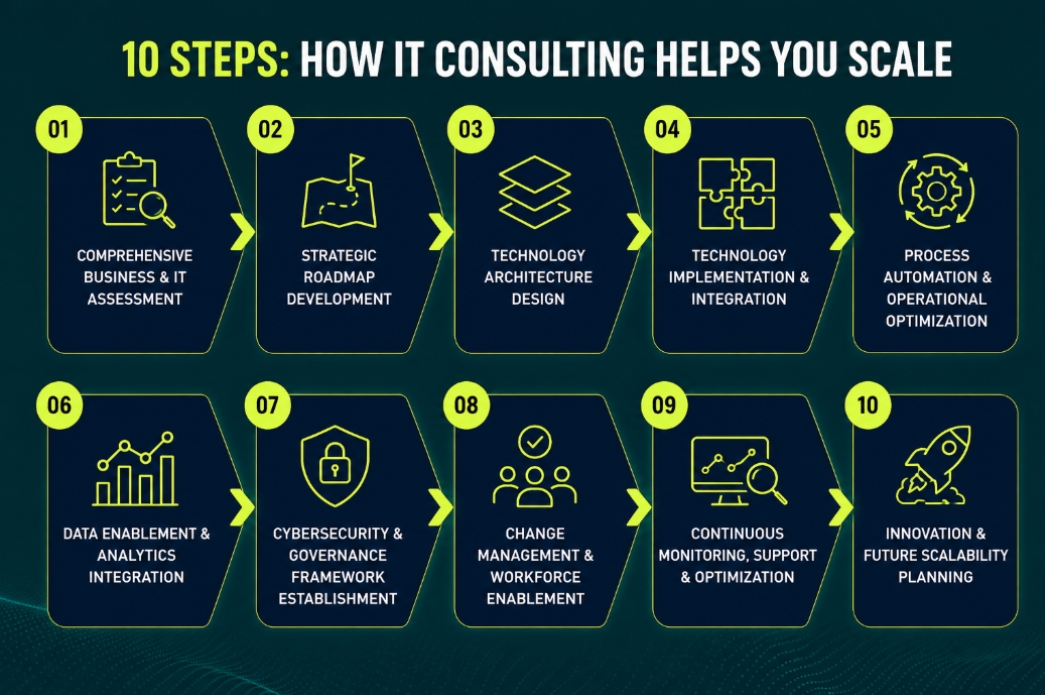
Step 1: Comprehensive Business & IT Assessment
The engagement begins with an in-depth evaluation of existing business processes, technological infrastructure, and operational capabilities. This diagnostic phase identifies systemic inefficiencies, capability gaps, and scalability constraints, establishing a clear baseline for transformation.
Step 2: Strategic Roadmap Development
Building on the assessment, consultants formulate a meticulously structured growth roadmap that aligns technology initiatives with business objectives. This blueprint outlines prioritized actions, investment strategies, and scalability milestones to ensure a cohesive and goal-oriented progression.
Step 3: Technology Architecture Design
At this stage, an exquisite and scalable enterprise architecture is conceptualized, ensuring unified interoperability between systems, platforms, and data ecosystems. The focus lies on creating a resilient and adaptable technological foundation capable of supporting future expansion.
Step 4: Technology Implementation & Integration
This phase involves the deployment of critical business solutions such as CRM systems, ERP platforms, and cloud-based infrastructures. Consultants ensure connected integration across all systems, minimizing disruption while maximizing operational continuity and efficiency.
Step 5: Process Automation & Operational Optimization
Leveraging advanced automation tools and intelligent workflows, IT consultants systematize operations, eliminate redundancies, and enhance productivity. This enables organizations to scale efficiently without proportional increases in operational complexity or cost.
Step 6: Data Enablement & Analytics Integration
To support informed decision-making, consultants implement data analytics frameworks and business intelligence tools. This empowers organizations with real-time insights, predictive capabilities, and enhanced visibility across all business functions.
Step 7: Cybersecurity & Governance Framework Establishment
A comprehensive security and compliance framework is instituted to safeguard digital assets, ensure regulatory adherence, and mitigate evolving cyber risks. This step is critical in maintaining trust and operational integrity during rapid scaling.
Step 8: Change Management & Workforce Enablement
Successful scaling requires organizational alignment. IT consultants facilitate change management initiatives, ensuring that teams are adequately trained, processes are adopted effectively, and cultural resistance is minimized.
Step 9: Continuous Monitoring, Support & Optimization
Post-implementation, consultants provide ongoing monitoring, performance evaluation, and iterative optimization. This ensures that systems remain efficient, scalable, and aligned with evolving business requirements.
Step 10: Innovation & Future Scalability Planning
Finally, IT consulting extends into forward-looking innovation, identifying emerging technologies and opportunities that can further enhance scalability. This ensures that the organization remains competitive, adaptive, and prepared for future growth trajectories.
Latest IT Consulting Trends in 2026
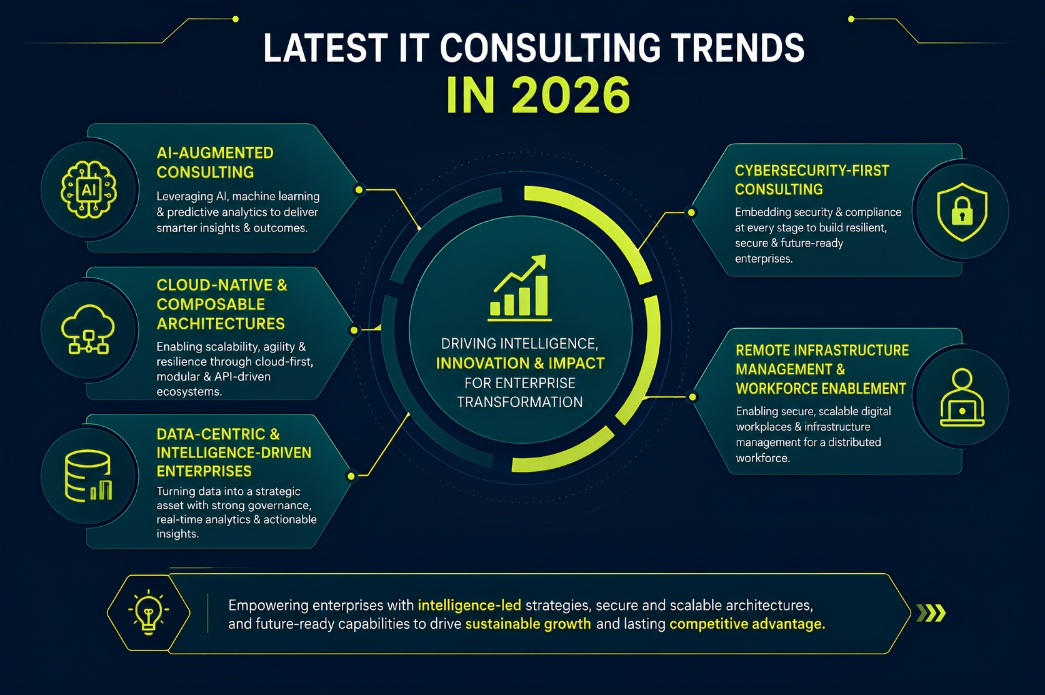
The IT consulting landscape in 2026 is characterized by a decisive shift toward intelligence-led, value-centric transformation, where technological innovation is intricately aligned with strategic business imperatives. As enterprises navigate an increasingly complex digital ecosystem, IT consulting has evolved beyond traditional advisory functions into a critical driver of enterprise-wide reinvention, enabling organizations to harness emerging technologies with precision and purpose.
A defining trend is the proliferation of AI-augmented consulting, where artificial intelligence is embedded across advisory, analytics, and operational frameworks. Consultants are leveraging advanced algorithms, machine learning models, and predictive analytics to deliver deeper insights, automate decision pathways, and enable highly personalized, data-driven strategies. This paradigm significantly enhances the speed, accuracy, and impact of consulting engagements.
Equally transformative is the dominance of cloud-native and composable architectures, which empower organizations to build modular, scalable, and highly adaptive technology ecosystems. IT consultants are increasingly guiding enterprises toward cloud-first strategies, emphasizing microservices, containerization, and API-driven integrations that facilitate impeccable scalability and operational fluidity across distributed environments.
Another prominent trend is the rise of data-centric and intelligence-driven enterprises, where data is treated as a strategic asset rather than a byproduct of operations. IT consulting now focuses on establishing robust data governance frameworks, real-time analytics capabilities, and advanced visualization tools that enable organizations to derive actionable insights and maintain a competitive edge.
In parallel, cybersecurity-first consulting has become a foundational priority, with security considerations embedded at every stage of the digital transformation lifecycle. As regulatory landscapes evolve and cyber threats become more sophisticated, consultants are designing resilient, compliance-oriented security architectures that safeguard critical assets while enabling secure scalability.
Furthermore, the emergence of remote infrastructure management and distributed workforce enablement reflects the changing nature of work. IT consultants are facilitating the adoption of secure, scalable digital workplaces that support global collaboration, ensuring operational continuity and productivity irrespective of geographical boundaries.
Collectively, these trends underscore a broader transition toward holistic, innovation-driven consulting paradigms, where IT consulting is not merely a support function but a strategic enabler of sustained growth, competitive differentiation, and long-term enterprise resilience in an increasingly digital-first world.
Common Mistakes Businesses Make Without IT Consulting
In the absence of structured IT consulting, organizations often navigate growth with limited strategic direction, resulting in fragmented technology decisions and suboptimal outcomes. Without expert guidance, businesses are more susceptible to inefficiencies, scalability constraints, and heightened operational risks—ultimately impeding their ability to achieve sustainable and accelerated growth.
1. Misaligned Technology Investments
Organizations frequently invest in technologies that lack alignment with their long-term strategic objectives, leading to underutilized systems and diminished return on investment.
2. Overreliance on Legacy Systems
Failure to modernize outdated infrastructure restricts scalability, reduces operational agility, and limits the organization’s ability to integrate with advanced digital solutions.
3. Fragmented Systems and Poor Integration
Disparate platforms operating in silos create inefficiencies, data inconsistencies, and hinder exquisite information flow across the enterprise.
4. Absence of a Scalable Technology Architecture
Without a well-defined architectural framework, businesses struggle to support expansion, resulting in performance capacity constraint and increased operational complexity.
5. Inefficient Manual Processes
Continued dependence on manual workflows limits productivity, increases the likelihood of errors, and restricts the organization’s ability to scale efficiently.
6. Inadequate Cybersecurity Measures
A lack of comprehensive security frameworks exposes organizations to data breaches, compliance risks, and reputational damage—particularly as digital operations expand.
7. Lack of Data-Driven Decision-Making
Without proper analytics and business intelligence frameworks, organizations rely on intuition rather than actionable insights, leading to suboptimal strategic decisions.
8. Ineffective Resource Allocation
Poor visibility into IT performance and requirements often results in inefficient allocation of financial and human resources, increasing operational costs.
9. Delayed Digital Transformation Initiatives
Hesitation or lack of expertise in adopting modern technologies slows innovation and places businesses at a competitive disadvantage.
10. Absence of Continuous Optimization and Governance
Without ongoing monitoring and performance evaluation, systems become outdated, inefficient, and misaligned with evolving business needs.
How to Choose the Right IT Consulting Partner
Selecting the right IT consulting partner is a strategic decision that extends far beyond vendor evaluation—it is about identifying a trusted advisor capable of aligning technology with long-term business vision. In an era where digital transformation directly influences competitive positioning, the right partner brings not only technical expertise but also strategic foresight, executional excellence, and a deep understanding of evolving market dynamics. A well-chosen IT consulting firm becomes an extension of your organization, enabling scalable growth, operational precision, and sustained innovation.
1. Demonstrated Strategic Expertise and Domain Proficiency
Evaluate the firm’s ability to translate complex business challenges into structured technology strategies, supported by proven industry experience and domain-specific knowledge.
2. Strong Enterprise Architecture Capabilities
A credible partner should possess the capability to design scalable, interoperable, and future-oriented technology architectures that align with your long-term growth trajectory.
3. Proven Track Record and Portfolio Credibility
Assess past engagements, case studies, and client outcomes to ensure the partner has consistently delivered measurable results across similar business environments.
4. Integration and Ecosystem Competence
The ability to consistently integrate diverse systems, platforms, and third-party applications is critical for ensuring operational cohesion and scalability.
5. Emphasis on Scalability and Future Readiness
Choose a partner that prioritizes long-term adaptability, ensuring that solutions are not only effective today but also capable of evolving with future business demands.
6. Exquisite Governance and Delivery Frameworks
A structured approach to project management, risk mitigation, and quality assurance is essential for ensuring timely delivery and consistent performance.
7. Cybersecurity and Compliance Expertise
Ensure the partner embeds security-first principles and adheres to regulatory standards, safeguarding your organization against evolving cyber threats.
8. Data-Driven and Insight-Oriented Approach
A strong consulting partner leverages analytics and performance metrics to guide decision-making, ensuring strategies are backed by actionable insights.
9. Change Management and Organizational Alignment
The partner should demonstrate the ability to drive adoption, train teams, and align internal stakeholders to ensure flawless implementation and long-term success.
10. Long-Term Support and Strategic Partnership Mindset
Beyond implementation, the right partner offers continuous support, optimization, and innovation—positioning themselves as a long-term collaborator in your growth journey.
Conclusion
In the dynamic and continually evolving business milieu of 2026, scalability is no longer dictated by incremental expansion but by the deliberate Harmonization of technology-driven transformation. Enterprises aspiring to achieve enduring growth must transcend conventional frameworks and adopt a more sophisticated, digitally integrated operating model—where every strategic, operational, and technological initiative is cohesively aligned with long-term value creation.
Within this ideology , IT consulting assumes a mission-critical role as a strategic catalyst for enterprise advancement. It empowers organizations to navigate complexity with discernment, architect resilient growth frameworks, and execute expansion initiatives with unwavering precision. Through the seamless convergence of advanced technologies, optimized operational constructs, and intelligence-led decision-making, IT consulting enables businesses to unlock scalable, adaptive, and performance-centric growth trajectories.
Ultimately, success in scaling within the 2026 landscape will be determined not merely by the velocity of growth, but by the strategic depth and technological foresight that underpin it. Organizations that embrace IT consulting as an integral component of their growth strategy will not only accelerate expansion but also cultivate a sustained competitive edge—positioning themselves as leaders in innovation, agility, and long-term market preeminence.
FAQs
In 2026, business scalability is intrinsically linked to technological sophistication and operational versatility . IT consulting provides organizations with the strategic direction, architectural expertise, and digital transformation capabilities required to scale efficiently while maintaining operational excellence and competitive relevance.
IT consulting enables sustainable growth by aligning technology investments with long-term business objectives, optimizing operational frameworks, and implementing scalable digital infrastructures that support continuous innovation and enterprise-wide adaptability.
Yes. A structured IT consulting engagement facilitates the Immersive modernization of legacy infrastructures through strategic migration planning, system integration, and phased implementation methodologies—ensuring operational continuity while enhancing technological capabilities.
A high-value IT consulting partner functions as a strategic advisor rather than a transactional vendor. Such firms combine domain expertise, architectural foresight, governance excellence, and innovation-driven methodologies to deliver measurable business outcomes and long-term strategic value.
IT consulting firms implement security-first frameworks, advanced risk mitigation protocols, and compliance-oriented governance structures that safeguard organizational assets, ensure regulatory adherence, and maintain stakeholder trust throughout the scaling process.
Organizations can expect enhanced operational efficiency, accelerated digital transformation, optimized resource utilization, improved decision-making capabilities, reduced technological risk, and the establishment of scalable, high-performance infrastructures that support sustained business expansion.