
Contents
- 1 Key Takeaways
- 2 Insights
- 3 What Does a Business Consultant Do?
- 4 Signs Your Business Needs a Consultant
- 5 Benefits of Hiring the Right Business Consultant
- 6 Factors to Consider When Choosing a Business Consultant
- 7 Questions to Ask Before Hiring a Consultant
- 8 Red Flags to Avoid
- 9 Steps to Hire the Right Business Consultant
- 10 How a Consultant Can Help Different Industries
- 11 Future Trends in Business Consulting
- 12 Conclusion
- 13 FAQs
Table of Contents
ToggleKey Takeaways
Choosing the right business consultant is a strategic decision that can directly influence your company’s growth, operational efficiency, and long-term success. The ideal consultant brings not only industry expertise and proven experience but also a deep understanding of your business vision and challenges. A strong consulting partnership delivers measurable results through fitted strategies, transparent communication, and data-driven decision-making.
- Prioritize consultants with proven industry expertise and measurable success stories.
- Look for strategic thinking, clear communication, and a customized approach to problem-solving.
- Choose a consultant who aligns with your long-term business goals and organizational vision.
Insights
In an increasingly sophisticated and highly competitive commercial landscape, selecting the right business consultant has evolved into a pivotal executive decision rather than a routine operational requirement. Exceptional consultants contribute far more than technical expertise—they deliver profound market intelligence, objective evaluation, and transformative business frameworks that empower organizations to achieve sustained growth and enduring market prominence. Their capacity to identify structural inefficiencies, uncover high-value opportunities, and synchronize business operations with shifting industry expectations can substantially influence organizational advancement.
An elite consulting engagement is founded upon expertise, discretion, innovation, and visionary leadership. The most valuable consultants possess an expansive understanding of complex business ecosystems and provide customized recommendations meticulously designed to address the distinct intricacies of each enterprise. Beyond credentials and professional experience, businesses should seek advisors who demonstrate intellectual sophistication, transparent communication, and an outcome-driven methodology that reinforces confidence throughout every phase of engagement.
In today’s corporate environment, organizations that invest in premium consulting expertise are often better positioned to strengthen operational fortitude, accelerate executive decision-making, and establish a sustainable competitive distinction within their industry. Selecting the right consultant is not simply about resolving immediate business concerns—it is about forming a long-term executive partnership capable of delivering enduring organizational excellence and commercial refinement.
- Premium business consulting empowers organizations with elevated strategic direction and executive-level insight.
- The most influential consultants provide customized, intelligence-driven solutions aligned with long-term commercial aspirations.
- Strong advisory collaborations encourage innovation, operational refinement, and sustainable enterprise expansion.
What Does a Business Consultant Do?
A business consultant functions as a high-level strategic advisor dedicated to elevating organizational performance, reinforcing commercial viability, and enabling enterprises to achieve sustained corporate excellence. Their responsibilities extend far beyond traditional advisory services—they undertake in-depth evaluations of corporate structures, identify performance deficiencies, and formulate sophisticated business initiatives engineered to enhance profitability, scalability, and executive efficiency.
Leveraging profound industry expertise and analytical acumen, business consultants assist organizations in navigating multifaceted market environments while enabling leadership teams to make informed and commercially advantageous decisions. They work in close alignment with senior management to evaluate operational inefficiencies, refine business architecture, optimize functional ecosystems, and uncover lucrative avenues for long-term expansion. From corporate transformation and financial optimization to market penetration and operational refinement, consultants provide the intellectual direction required to preserve market relevance and competitive superiority.
An accomplished consultant also delivers an impartial external perspective, allowing businesses to recognize overlooked opportunities and address structural vulnerabilities with greater precision. Their strategic insight supports risk mitigation, productivity enhancement, customer experience elevation, and enterprise-wide performance advancement. In today’s increasingly sophisticated commercial landscape, business consultants play an indispensable role in enabling organizations to evolve with confidence, strengthen executive decision-making, and achieve enduring commercial distinction.
- Business consultants evaluate complex corporate environments and formulate intelligence-driven business frameworks.
- They empower executive leadership through analytical insights, operational advancement, and expansion-focused planning.
- Their expertise strengthens organizational performance, market authority, and long-term commercial sustainability.
Signs Your Business Needs a Consultant

Within the modern corporate landscape, even the most established organizations can encounter periods of stagnation, operational inefficiency, or strategic uncertainty. While many businesses attempt to resolve these complexities internally, the absence of specialized expertise and objective insight often delays growth and weakens long-term market positioning. This is precisely where an accomplished business consultant becomes invaluable. A distinguished consultant brings executive-level perspective, analytical precision, and transformative guidance capable of identifying hidden inefficiencies, unlocking untapped opportunities, and repositioning businesses for sustainable commercial advancement.
Recognizing the early indicators that your organization requires professional consulting support can prevent costly setbacks and accelerate strategic progress. Businesses that proactively seek expert advisory services are often better equipped to enhance operational performance, strengthen leadership decisions, and maintain a refined competitive edge within evolving markets.
Persistent Decline in Business Growth
When revenue growth, client acquisition, or overall business performance begins to plateau despite continuous efforts, it may indicate deeper structural or strategic deficiencies. A business consultant can conduct a comprehensive performance evaluation and introduce sophisticated growth frameworks designed to restore momentum and profitability.
Inefficient Operational Performance
Disorganized workflows, recurring delays, and resource mismanagement can significantly diminish productivity and financial efficiency. Consultants identify operational bottlenecks and implement optimized business processes that improve organizational performance and functional precision.
Lack of Strategic Direction
Businesses operating without a clearly defined long-term vision often struggle with inconsistent decision-making and market positioning. A consultant provides strategic clarity, helping organizations establish measurable objectives, sustainable growth plans, and executive-level business direction.
Difficulty Adapting to Market Changes
Rapid industry evolution, technological advancement, and shifting consumer expectations require businesses to remain responsive and forward-focused. Consultants offer market intelligence and innovation-driven strategies that help organizations adapt with confidence and maintain industry relevance.
Leadership Overextension
When senior management becomes overwhelmed with operational complexities, it can limit the organization’s ability to focus on expansion and innovation. Business consultants provide specialized support, enabling leadership teams to prioritize high-value strategic initiatives more effectively.
Declining Customer Satisfaction
Consistent client dissatisfaction, poor retention rates, or negative brand perception often indicate gaps in service quality or operational execution. Consultants help businesses refine customer experience strategies, strengthen brand credibility, and elevate client engagement standards.
Challenges During Business Expansion
Scaling a business without the appropriate systems, infrastructure, or strategic planning can create operational instability. Consultants assist organizations in managing expansion with calculated precision, ensuring sustainable and profitable growth.
- Business consultants help organizations identify hidden inefficiencies and strategic gaps before they escalate into major challenges.
- Expert advisory support strengthens operational excellence, leadership efficiency, and long-term market positioning.
- Proactively engaging a consultant enables businesses to navigate complexity with greater confidence, clarity, and commercial sophistication.
Benefits of Hiring the Right Business Consultant

Engaging the right business consultant is far more than a professional investment—it is a strategic decision that can redefine the trajectory of an organization. In an increasingly progressive commercial environment, businesses require more than operational guidance; they need refined proficiency, market intelligence, and executive-level direction capable of driving sustainable advancement. A highly qualified consultant introduces an external perspective, identifies untapped opportunities, and delivers transformative recommendations that strengthen both immediate performance and long-term corporate positioning.
Organizations that collaborate with the right consultant often gain enhanced clarity, stronger operational control, and a more decisive approach to business growth. Their proficiency empowers leadership teams to navigate complexities with precision while reinforcing profitability, innovation, and organizational excellence.
Enhanced Strategic Decision-Making
Experienced business consultants provide data-driven insights and objective evaluations that enable leadership teams to make informed, commercially advantageous decisions with greater confidence and precision.
Improved Operational Efficiency
Consultants assess internal processes, identify structural inefficiencies, and implement refined operational methodologies that elevate productivity, performance, and resource optimization across the organization.
Accelerated Business Growth
With extensive market knowledge and strategic foresight, consultants help businesses uncover profitable opportunities, strengthen market positioning, and achieve sustainable commercial expansion.
Objective External Perspective
An external consultant offers an impartial and unbiased assessment of business operations, allowing organizations to identify overlooked challenges, hidden risks, and untapped potential with greater clarity.
Stronger Financial Performance
By optimizing operational structures and improving strategic planning, consultants contribute to enhanced profitability, controlled expenditures, and improved long-term financial stability.
Greater Adaptability to Market Evolution
As industries continue to evolve, consultants help organizations remain competitive by introducing innovation-focused strategies, modern business frameworks, and forward-thinking commercial solutions.
Executive-Level Guidance Without Long-Term Commitment
Hiring a consultant allows businesses to access specialized industry proficiency and high-level strategic guidance without the financial obligations associated with permanent executive appointments.
Increased Organizational Confidence
A well-structured consulting partnership reinforces leadership confidence by providing clear direction, measurable objectives, and professionally guided business transformation initiatives.
- The right business consultant strengthens strategic clarity, operational performance, and long-term profitability.
- Professional advisory support enables organizations to navigate market complexities with confidence and commercial precision.
- Premium consulting partnerships foster innovation, sustainable growth, and elevated corporate excellence.
Factors to Consider When Choosing a Business Consultant
Selecting a business consultant is a decision that extends far beyond reviewing credentials or professional experience—it is about identifying a trusted advisor capable of influencing the future direction of your organization. In a highly competitive commercial environment, businesses require consultants who possess strategic intelligence, industry insight, and the capability to deliver measurable corporate advancement. The right consultant not only addresses immediate operational concerns but also contributes to long-term organizational refinement, profitability, and market distinction.
A successful consulting engagement is built upon credibility, analytical excellence, and a profound understanding of business complexities. Organizations should evaluate consultants with careful consideration, ensuring their professional approach, leadership perspective, and commercial understanding correspond effectively with the company’s long-term objectives and corporate vision.
Industry Knowledge and Professional Background
A consultant with extensive industry exposure possesses a deeper understanding of market dynamics, commercial challenges, and sector-specific opportunities. Their professional background significantly influences the quality and effectiveness of strategic recommendations.
Proven Record of Commercial Success
Before engaging a consultant, businesses should assess their portfolio, case studies, and client achievements. A strong history of delivering measurable outcomes reflects credibility, reliability, and strategic competence.
Strategic Thinking and Analytical Capability
Exceptional consultants demonstrate the ability to evaluate complex business scenarios with exceptional accuracy and formulate intelligent, result-oriented recommendations that support organizational objectives.
Communication and Executive Presence
Clear communication, professional conduct, and executive-level presentation skills are essential qualities in a consultant. Their ability to articulate strategies with confidence strengthens collaboration and organizational trust.
Customized Business Approach
Every organization operates within unique commercial circumstances. The ideal consultant delivers personalized recommendations and business frameworks specifically aligned with the company’s operational structure, objectives, and market positioning.
Transparency and Professional Integrity
Trust forms the foundation of every successful consulting partnership. Businesses should prioritize consultants who maintain transparency, ethical professionalism, and accountability throughout the engagement process.
Adaptability and Market Awareness
An effective consultant remains informed about emerging industry developments, market fluctuations, and evolving business practices. Their commercial awareness enables organizations to remain competitive and strategically progressive.
Long-Term Value Creation
The right consultant contributes far beyond short-term problem resolution. Their guidance should strengthen operational excellence, leadership effectiveness, and sustainable business growth over an extended period.
- Selecting the right business consultant requires careful evaluation of industry knowledge, credibility, and strategic capability.
- Strong consulting partnerships are built upon transparency, executive communication, and commercial intelligence.
- The ideal consultant delivers long-term organizational value through refined strategies and measurable business advancement.
Questions to Ask Before Hiring a Consultant
Appointing a business consultant is a consequential executive decision that can substantially influence an organization’s commercial direction, operational excellence, and long-term corporate prosperity. Before formalizing a consulting engagement, businesses must undertake a meticulous evaluation process to determine whether the consultant possesses the intellectual capital, strategic discernment, and commercial acumen required to deliver meaningful organizational advancement. The questions raised during this evaluation stage are instrumental in establishing credibility, professional transparency, and strategic compatibility.
What Depth of Industry Exposure Do You Possess?
A consultant with extensive sector-specific exposure demonstrates a more comprehensive understanding of industry intricacies, competitive dynamics, regulatory environments, and evolving commercial expectations. Their familiarity with the sector significantly enhances the relevance and effectiveness of their strategic recommendations.
Can You Demonstrate a Proven History of Commercial Achievement?
Requesting detailed case studies, performance metrics, and client success narratives provides valuable insight into the consultant’s ability to deliver measurable outcomes, operational refinement, and sustainable business progression.
What Methodology Defines Your Strategic Advisory Process?
Understanding a consultant’s strategic methodology reveals their analytical capabilities, decision-making framework, and approach toward resolving multifaceted business complexities with commercial intelligence and executive precision.
How Do You Evaluate Organizational Performance and Success?
An accomplished consultant should establish clearly defined performance indicators, measurable benchmarks, and result-oriented objectives that allow businesses to assess the effectiveness and commercial value of the engagement.
What Is Your Communication and Reporting Structure?
Professional consulting relationships require exceptional communication standards. Businesses should assess the consultant’s reporting practices, engagement frequency, responsiveness, and executive communication style to ensure operational coherence throughout the partnership.
Which Areas of Corporate Advisory Represent Your Core Specialization?
Consultants frequently possess specialized proficiencies in areas such as operational optimization, financial restructuring, leadership advisory, market expansion, or organizational transformation. Identifying these specializations ensures strategic alignment with business priorities.
How Do You Navigate Organizational Resistance and Structural Transition?
Corporate transformation initiatives often encounter internal resistance and operational disruption. A distinguished consultant should possess the leadership maturity and interpersonal sophistication necessary to manage change with stability and executive confidence.
What Enduring Value Will Your Advisory Services Deliver?
Beyond addressing immediate business concerns, organizations should evaluate how the consultant’s involvement will contribute to sustained commercial distinction, operational enhancement, and long-term executive development.
How Will Your Recommendations Correspond With Our Organizational Framework?
Every enterprise operates within a distinct corporate structure and commercial environment. A high-caliber consultant should demonstrate the adaptability to formulate refined strategies that correspond effectively with the organization’s operational model, leadership philosophy, and long-term aspirations.
- Thoughtfully structured questions enable businesses to identify consultants with exceptional strategic intelligence and professional credibility.
- A distinguished consultant contributes not only to immediate operational advancement but also to enduring corporate refinement and sustainable commercial progression.
- Transparency, executive communication, and measurable performance standards are fundamental pillars of a successful consulting engagement.
Red Flags to Avoid

Engaging a business consultant is a decision that demands exceptional diligence, commercial discernment, and strategic evaluation. While the right consultant can contribute significantly to organizational refinement and long-term corporate advancement, an ill-suited advisory partnership can compromise operational efficiency, weaken executive decision-making, and impede sustainable growth. In an increasingly competitive business environment, organizations must exercise heightened scrutiny when assessing consulting professionals and remain attentive to indicators that may reflect inadequate strategic capability, limited commercial understanding, or questionable professional ethics.
Absence of Demonstrable Industry Credibility
A consultant who lacks verifiable industry accomplishments, credible client associations, or documented business outcomes may not possess the commercial insight required to navigate complex organizational environments effectively.
Exaggerated Commitments and Unrealistic Assurances
Professionals who promise immediate transformation, guaranteed profitability, or accelerated success without conducting a comprehensive organizational assessment should be approached with considerable caution. Authentic business progression requires calculated strategy, market intelligence, and disciplined execution.
Deficient Communication Standards
Inconsistent communication, ambiguous responses, or a lack of clarity regarding strategic recommendations often reflects inadequate professionalism and limited operational accountability.
Reliance on Conventionalized Solutions
Organizations possess distinct operational structures, leadership cultures, and commercial objectives. Consultants who apply generic methodologies without conducting in-depth business evaluation frequently fail to deliver meaningful or sustainable results.
Restricted Strategic Perspective
Consultants who focus exclusively on short-term corrective measures while disregarding long-term organizational progression may limit a company’s capacity for sustained commercial distinction and market relevance.
Ambiguity in Commercial Terms and Deliverables
Undefined engagement structures, unclear pricing models, or vague performance expectations can create operational misunderstandings and erode professional trust throughout the advisory relationship.
Resistance Toward Accountability and Performance Evaluation
A credible consultant welcomes transparency, measurable performance standards, and structured reporting mechanisms. Reluctance to establish accountability frameworks may indicate insufficient confidence in their strategic recommendations or professional capabilities.
Compromised Professional Reputation
Negative client experiences, inconsistent testimonials, or the absence of reputable references can signify concerns regarding reliability, service standards, and professional integrity.
Inability to Integrate Within Organizational Culture
An effective consultant must possess the interpersonal sophistication and executive adaptability required to correspond with the organization’s leadership philosophy, operational environment, and corporate ethos. Failure to establish this compatibility can weaken collaboration and strategic execution.
- Recognizing professional warning indicators early protects organizations from ineffective advisory engagements and commercial disruption.
- Credibility, transparency, and strategic intelligence remain fundamental attributes of a distinguished business consultant.
- The right consulting partnership strengthens operational excellence and executive confidence, while the wrong association can hinder long-term organizational progression.
Steps to Hire the Right Business Consultant
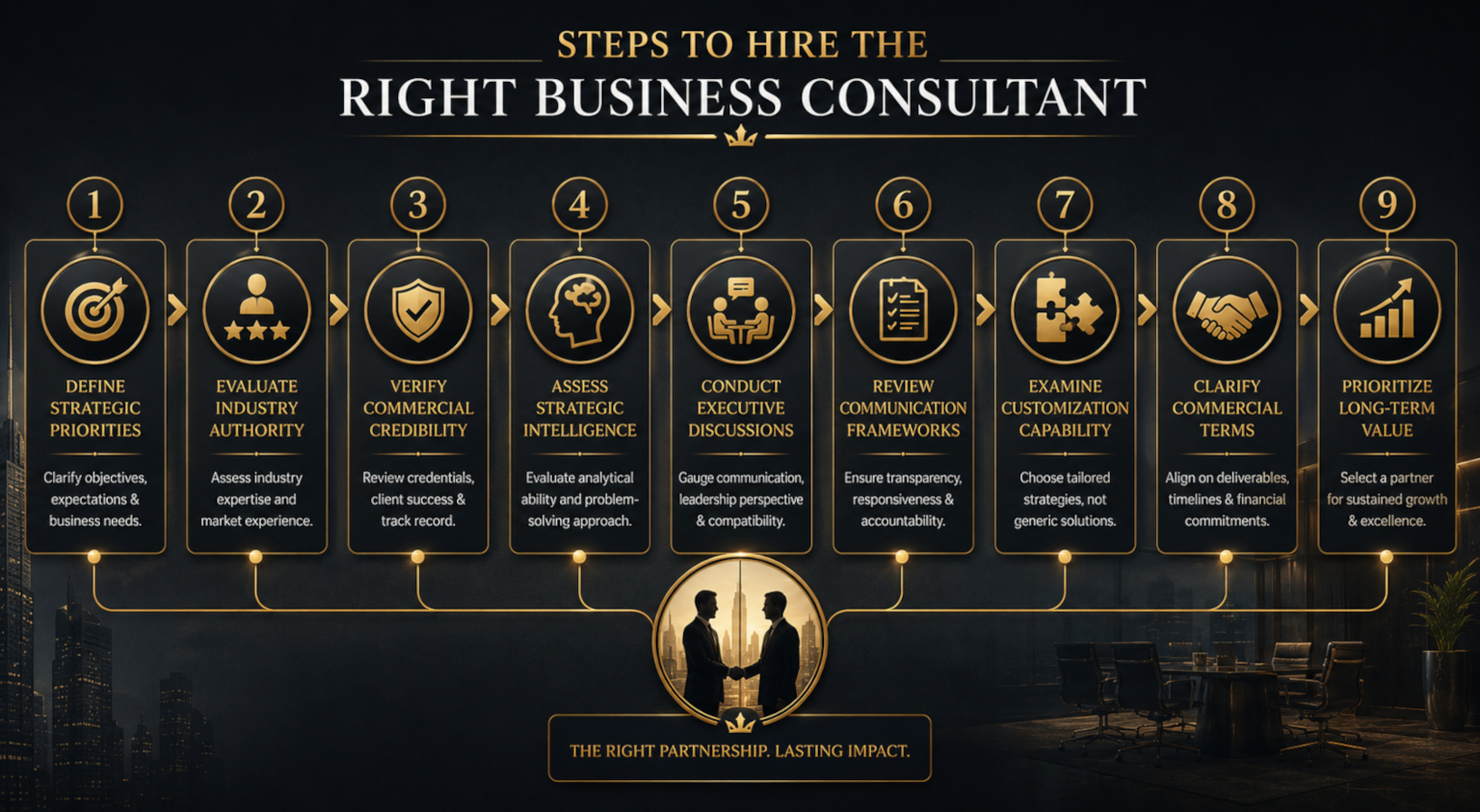
Appointing the right business consultant is a sophisticated executive decision that demands strategic clarity, commercial discernment, and meticulous evaluation. In an increasingly competitive corporate landscape, organizations require more than conventional advisory support—they need distinguished professionals capable of delivering visionary direction, operational refinement, and measurable commercial elevation. A highly accomplished consultant contributes intellectual insight, market intelligence, and transformative business perspectives that strengthen long-term organizational prestige and profitability.
Businesses that approach the consultant selection process with precision and professional rigor are far more likely to cultivate advisory partnerships that generate enduring commercial value, executive confidence, and sustainable corporate distinction.
Define Strategic Priorities
Establish clear organizational objectives, commercial expectations, and operational requirements before initiating the selection process.
Evaluate Industry Authority
Assess the consultant’s sector-specific exposure, market understanding, and professional accomplishments within your industry.
Verify Commercial Credibility
Review client portfolios, success narratives, testimonials, and measurable achievements to validate professional reliability.
Assess Strategic Intelligence
Examine the consultant’s analytical thinking, decision-making capability, and approach toward resolving complex business challenges.
Conduct Executive-Level Discussions
Engage in detailed consultations to evaluate communication standards, leadership perspective, and strategic compatibility.
Review Communication Frameworks
Ensure the consultant maintains transparent reporting structures, professional responsiveness, and operational accountability.
Examine Customization Capability
Prioritize consultants who deliver refined, organization-specific strategies rather than generalized advisory frameworks.
Clarify Commercial Terms
Establish precise expectations regarding deliverables, timelines, engagement structures, and financial commitments.
Prioritize Long-Term Commercial Value
Select consultants capable of contributing to sustained organizational advancement, executive refinement, and enduring market distinction.
- Define objectives with clarity.
- Prioritize credibility and industry authority.
- Seek strategic intelligence and refinement.
- Ensure transparency and executive communication.
- Invest in long-term commercial excellence.
How a Consultant Can Help Different Industries
Amid rapidly evolving market dynamics and intensifying corporate competition, businesses must adopt advanced strategies to preserve growth, relevance, and commercial distinction. Professional business consultants provide strategic insight, executive-level direction, and industry-specific intelligence that strengthen operational performance and long-term profitability
Healthcare Industry
Within the healthcare sector, consultants assist organizations in enhancing operational efficiency, patient experience, regulatory compliance, and financial performance. They help healthcare institutions optimize administrative processes, improve resource allocation, and implement modernized operational systems that elevate service excellence and institutional credibility.
Key Contributions:
- Operational refinement
- Regulatory compliance support
- Patient experience enhancement
- Financial performance optimization
Manufacturing Industry
Manufacturing enterprises often face challenges related to production efficiency, supply chain coordination, and cost management. Consultants introduce advanced operational methodologies, performance optimization strategies, and process enhancement frameworks that strengthen productivity and commercial sustainability.
Key Contributions:
- Production efficiency improvement
- Supply chain optimization
- Cost-control strategies
- Quality assurance enhancement
Retail and E-Commerce Industry
Retail and e-commerce businesses operate within rapidly evolving consumer markets where customer expectations and purchasing behaviors continuously transform. Consultants help brands refine customer engagement strategies, strengthen digital positioning, and optimize sales performance through data-driven commercial insights.
Key Contributions:
- Consumer behavior analysis
- Brand positioning refinement
- Digital commerce optimization
- Customer retention strategies
Financial Services Industry
Financial institutions require strategic oversight, regulatory precision, and operational security to maintain market confidence and institutional stability. Consultants support financial organizations by improving risk management practices, strengthening operational governance, and identifying opportunities for commercial expansion.
Key Contributions:
- Risk management enhancement
- Regulatory advisory support
- Financial planning refinement
- Operational governance improvement
Hospitality Industry
The hospitality industry depends heavily on customer satisfaction, service excellence, and brand perception. Consultants assist hospitality businesses in elevating guest experiences, optimizing operational workflows, and strengthening competitive positioning within a highly service-oriented market.
Key Contributions:
- Guest experience optimization
- Revenue growth strategies
- Service quality enhancement
- Brand reputation management
Technology Industry
Technology companies operate within a fast-evolving environment driven by innovation, scalability, and digital transformation. Consultants help technology enterprises develop expansion strategies, improve operational scalability, and strengthen market competitiveness through forward-thinking commercial frameworks.
Key Contributions:
- Digital transformation guidance
- Business scalability support
- Innovation strategy development
- Market competitiveness enhancement
Real Estate Industry
Real estate organizations require strategic planning, market intelligence, and financial precision to maximize profitability and investment performance. Consultants provide advisory support related to market analysis, investment strategy, operational management, and customer acquisition.
Key Contributions:
- Market intelligence evaluation
- Investment strategy refinement
- Sales process enhancement
- Customer acquisition optimization
Education Industry
Educational institutions increasingly require operational modernization, technological advancement, and improved student engagement strategies. Consultants support institutions in strengthening administrative systems, academic operations, and institutional growth initiatives.
Key Contributions:
- Institutional growth planning
- Academic process optimization
- Student engagement enhancement
- Technology integration support
Food and Restaurant Industry
Restaurants and food enterprises must consistently balance operational efficiency, customer satisfaction, and profitability. Consultants help businesses improve operational structures, optimize service delivery, strengthen brand identity, and elevate customer retention.
Key Contributions:
- Operational efficiency enhancement
- Customer experience refinement
- Brand identity strengthening
- Revenue optimization strategies
Logistics and Transportation Industry
Logistics businesses require precision, operational coordination, and cost-effective supply chain management to maintain efficiency and competitiveness. Consultants assist organizations in improving logistical frameworks, resource utilization, and distribution performance.
Key Contributions:
- Supply chain optimization
- Distribution efficiency improvement
- Operational cost reduction
- Resource management refinement
Final Perspective
Across every industry, business consultants contribute strategic intelligence, operational refinement, and executive-level guidance that enable organizations to achieve sustainable commercial progression. Their expertise extends beyond problem resolution—they help businesses unlock new opportunities, strengthen organizational resilience, and establish enduring market distinction within increasingly competitive environments.
- Consultants provide industry-specific strategic insight and operational refinement.
- Professional advisory support enhances profitability, efficiency, and market authority.
- Strategic consulting empowers industries to achieve sustainable growth and long-term commercial excellence.
Future Trends in Business Consulting
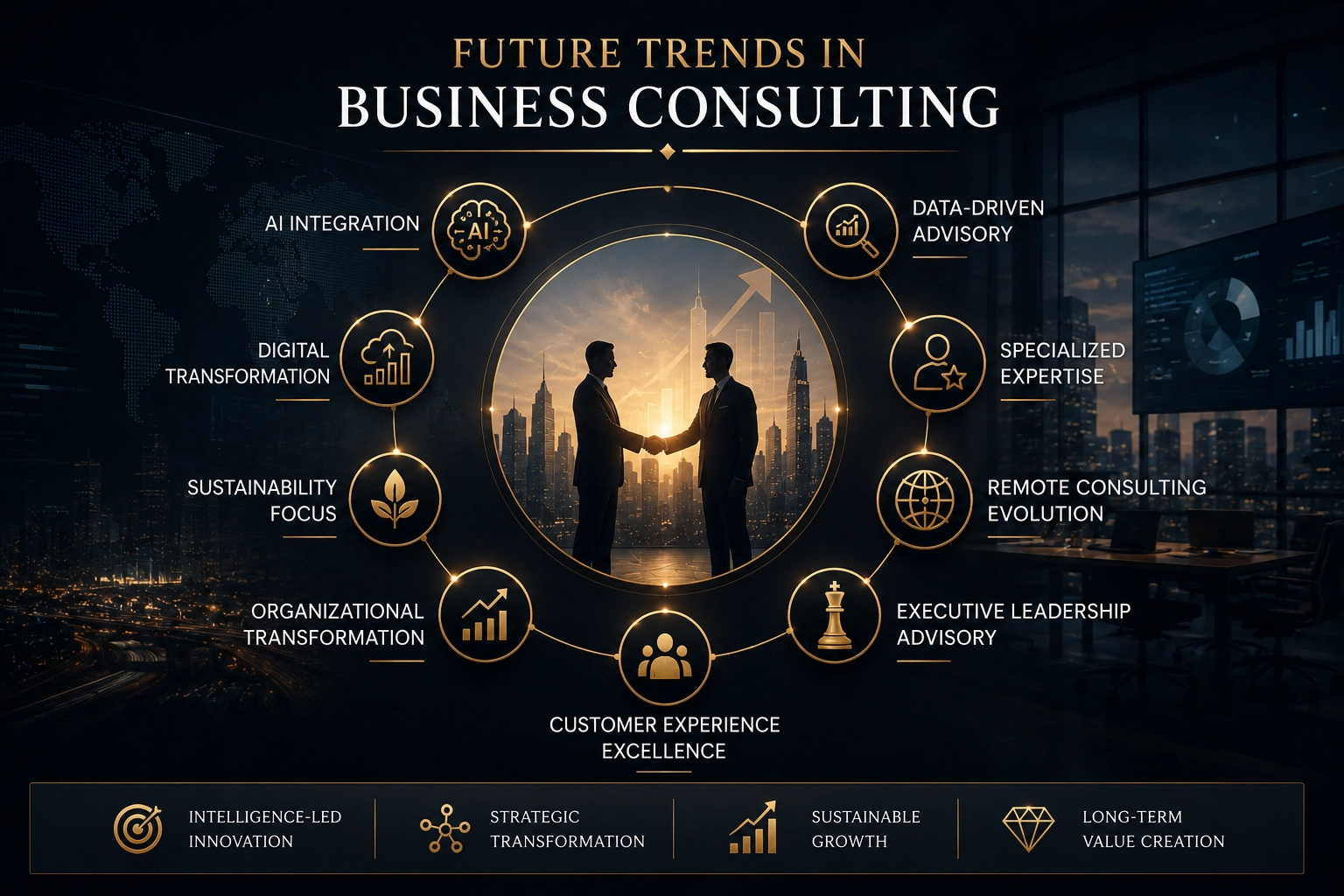
As global industries continue to evolve within an increasingly competitive commercial environment, the business consulting sector is undergoing a profound transformation. Modern organizations are no longer seeking conventional advisory services alone—they require visionary guidance, innovation-driven strategies, and commercially intelligent solutions capable of sustaining long-term organizational advancement. The future of business consulting will be defined by technological evolution, data-centric decision-making, operational modernization, and heightened demand for specialized strategic advisory.
Consultants of the future will serve not merely as advisors, but as influential growth partners who help organizations navigate market disruption, accelerate transformation initiatives, and establish enduring commercial distinction. Businesses that embrace emerging consulting trends will be significantly better positioned to strengthen operational performance, improve executive decision-making, and maintain competitive superiority within rapidly evolving markets.
Advanced Artificial Intelligence Integration
Artificial Intelligence is redefining the consulting landscape through predictive commercial analysis, intelligent automation, and enhanced strategic forecasting. Consultants are leveraging advanced AI capabilities to deliver commercially astute recommendations with greater analytical depth and operational effectiveness.
Elevated Demand for Intelligence-Led Advisory
Organizations increasingly prioritize consultants capable of transforming complex commercial data into refined strategic insight. Intelligence-driven consulting empowers executive leadership with informed decision-making, market clarity, and commercially advantageous direction.
Expansion of Specialized Executive Consulting
Businesses are seeking highly specialized consultants with profound sector-specific understanding and elite commercial proficiency. Industry-focused advisory services deliver exceptionally refined strategies curated to sophisticated operational environments.
Acceleration of Digital Transformation Initiatives
As enterprises continue to modernize operational infrastructures, consultants are playing an instrumental role in guiding digital transformation, enterprise modernization, and technological advancement to strengthen scalability and organizational performance.
Evolution of Global Remote Consulting Models
The advancement of digital communication ecosystems has elevated remote consulting into a globally integrated advisory model. Organizations now access world-class strategic consultation with greater flexibility, executive convenience, and international commercial exposure.
Heightened Emphasis on Corporate Sustainability
Sustainable business practices are becoming central to modern corporate prestige and long-term organizational relevance. Consultants are increasingly assisting enterprises in developing environmentally responsible strategies, ethical governance structures, and sustainability-focused commercial frameworks.
Refinement of Customer Experience Strategy
Customer experience has emerged as a defining element of premium brand distinction. Consultants are helping organizations elevate customer engagement standards, strengthen brand loyalty, and cultivate highly refined service experiences that reinforce market prestige.
Greater Focus on Organizational Transformation
Continuous market evolution requires businesses to navigate organizational transformation with executive precision and operational stability. Consultants are increasingly providing leadership transition guidance, workforce alignment strategies, and structural transformation expertise.
Expansion of Executive Leadership Advisory
Executive leadership consulting continues to gain prominence as organizations prioritize leadership excellence, succession planning, and executive performance refinement to sustain long-term corporate distinction.
- Future consulting will be defined by intelligence-led innovation and executive-level strategic refinement.
- Organizations increasingly seek specialized advisory partnerships focused on transformation, sustainability, and market prestige.
- Modern consultants are evolving into influential commercial architects driving long-term organizational eminence and competitive superiority.
Conclusion
At the highest echelon of modern enterprise, where commercial prestige, executive influence, and organizational distinction define enduring success, the appointment of a business consultant transcends conventional professional engagement and emerges as a strategic embodiment of corporate ambition, visionary leadership, and institutional sophistication. In an era characterized by accelerated market evolution, elevated competitive intensity, and uncompromising performance expectations, organizations require advisory excellence that extends beyond operational guidance and delivers transformative commercial intelligence of the highest caliber.
A distinguished business consultant contributes an exceptional depth of strategic acumen, executive discernment, and commercially astute perspective capable of redefining organizational trajectory and reinforcing long-term market eminence. Their advisory influence permeates every dimension of enterprise performance—enhancing executive decision-making, refining operational architecture, strengthening profitability frameworks, and uncovering avenues of sustained commercial distinction that position organizations at the forefront of their industries.
The value of an elite consulting partnership resides not solely in problem resolution, but in its capacity to cultivate institutional prestige, operational superiority, and enduring corporate relevance within an increasingly sophisticated global marketplace. Businesses that align themselves with highly accomplished consultants secure access to refined strategic intelligence, elevated leadership direction, and transformative business methodologies that reinforce sustainable commercial prosperity and executive excellence.
Ultimately, the right consultant functions as far more than an external advisor—they become a pivotal architect of organizational evolution, empowering enterprises to establish a legacy defined by innovation, market authority, corporate grandeur, and enduring commercial supremacy.
FAQs
Engaging a distinguished business consultant enables organizations to access refined commercial intelligence, executive-level strategic guidance, and industry-specific expertise that strengthen profitability, operational excellence, and long-term corporate distinction. A premium consulting partnership contributes directly to sustainable organizational advancement and elevated market positioning.
An accomplished consultant evaluates operational structures, identifies performance inefficiencies, and formulates commercially sophisticated strategies that optimize productivity, executive decision-making, financial performance, and overall organizational effectiveness.
A highly proficient consultant demonstrates strategic acumen, extensive industry exposure, analytical excellence, executive communication capability, and a proven history of delivering measurable commercial outcomes. Professional integrity, transparency, and visionary leadership are equally essential attributes.
Organizations experiencing operational stagnation, declining profitability, leadership challenges, market adaptation difficulties, or strategic uncertainty often benefit significantly from professional consulting intervention. Consultants provide objective commercial insight and transformative strategic direction during critical phases of organizational progression.
Yes. Premium consultants frequently specialize in distinct industries and possess comprehensive sector-specific understanding. Their expertise enables them to deliver refined advisory frameworks configured to the operational complexities, commercial expectations, and competitive dynamics of a particular industry.
Beyond immediate operational enhancement, an elite consulting partnership contributes to sustainable commercial growth, executive refinement, organizational resilience, and enduring market distinction. The right consultant helps businesses cultivate innovation, strengthen strategic vision, and achieve long-term corporate eminence.