
Contents
- 1. Key Takeaways
- 2. Introduction
- 3. What "Pilot Purgatory" Actually Looks Like
- 4. The Numbers: How Big Is the Production Gap, Really?
- 5. Why Regulated and Legacy-Heavy Industries Have It Even Harder
- 6. Why AI Agent Pilots Fail: Five Recurring Reasons
- 7. The Hidden Cost of Staying in Pilot Purgatory
- 8. A Realistic Example: Demo vs. Production
- 9. How to Be in the Minority That Actually Ships
- 10. What This Means If You're Evaluating an AI Agent Project Right Now
- 11. Conclusion
- 12. FAQs
Table of Contents
ToggleKey Takeaways
- Most AI agent pilots don’t fail because the technology doesn’t work — they stall because of missing governance, ownership, data readiness, and integration planning.
- Industry data consistently shows a large gap between organizations piloting AI agents and those with agents running reliably in production — often cited in the range of 80-90%.
- Narrow, well-defined use cases are far more likely to reach production than broad, ambitious ones.
Governance, integration, and clear ownership need to be part of the project from day one, not added after the pilot proves the concept. - Success should be measured in business outcomes — time saved, cost reduced, errors avoided — not model accuracy alone.
Introduction
Your team built an AI agent. It worked in the demo. The leadership was impressed. The budget got approved for a bigger rollout.
Then, quietly, it stalled.
If that sounds familiar, you’re not alone — and you’re not doing anything unusually wrong. Across nearly every recent industry survey, the pattern is the same: most organizations that pilot an AI agent never get it into real, ongoing production use. The gap between “it worked in the demo” and “it’s actually running our business” is wider for AI agents than for almost any technology wave before it.
This isn’t a piece about whether AI agents are worth building — they are, when scoped correctly. It’s about why so many pilots quietly die before they ever create business value, what makes AI agents fail differently than earlier software projects, and what separates the organizations that make it to production from the ones stuck repeating the same demo for another budget cycle.
What "Pilot Purgatory" Actually Looks Like
Most AI agent pilots don’t fail loudly. There’s rarely a dramatic collapse, a canceled contract, or an executive memo announcing the project is dead. Instead, the project enters what practitioners have started calling “pilot purgatory” — a stalled state that can drag on for months, sometimes years, without ever being formally declared a failure.
A handful of signs tend to show up together when a project is stuck here:
- The pilot works fine in a controlled test but never gets expanded to more users, departments, or workflows.
- The original team that built it moves on to other priorities, and no one is formally responsible for pushing it forward.
- Leadership’s enthusiasm cools after the initial demo excitement fades, without ever getting a clear, honest answer about why it stalled.
- The project keeps getting described as “almost ready for phase two” for multiple budget cycles in a row.
- The budget quietly gets reallocated at the next planning meeting, and nobody officially closes the project — it just fades.
- The team can point to a working demo recording, but can’t point to a single real business metric the agent has moved.
None of these signs look like failure on a status report. That’s exactly what makes pilot purgatory so common — and so easy for an organization to sit in for a long time without recognizing it.
Tip:
If your AI agent project has been “almost ready for the next phase” for more than two quarters, it’s very likely already in pilot purgatory — even if no one has said so out loud in a meeting.
The Numbers: How Big Is the Production Gap, Really?
Depending on which industry survey you look at, the exact figures vary — but they all point the same direction, and the consistency across independent researchers is itself worth paying attention to.
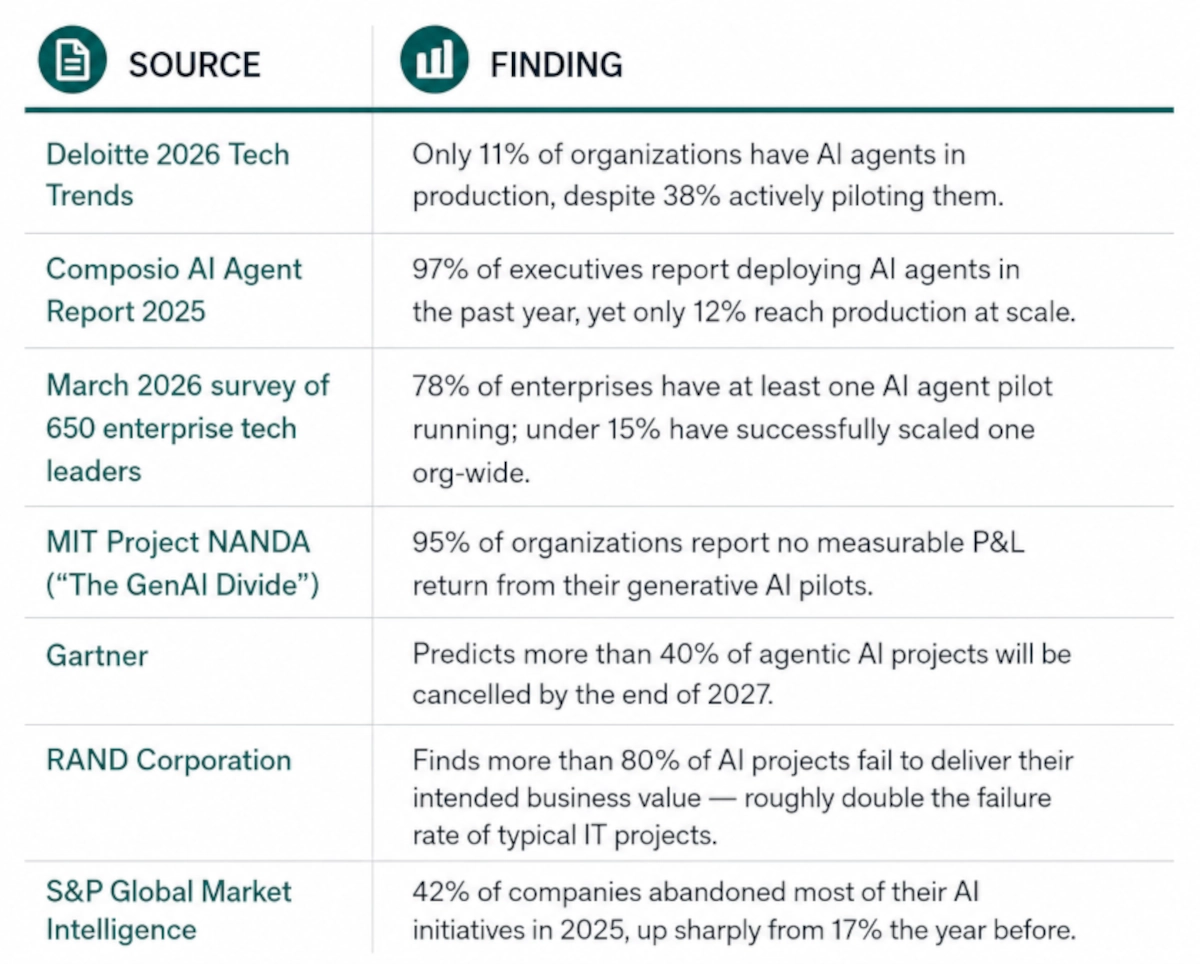
A few things stand out when you look at these together rather than one at a time.
First, the gap isn’t about willingness to try. Almost every organization surveyed is experimenting with AI agents — adoption of the pilot stage is close to universal. The bottleneck is entirely downstream of that first step.
Second, the gap is widening, not narrowing, as more companies pile in. The jump in abandoned initiatives from 17% to 42% in a single year (S&P Global) suggests that as more organizations rush to pilot AI agents without the groundwork in place, more of them are hitting the same wall and giving up, rather than the industry collectively getting better at this over time.
Third, the technology itself keeps improving while the success rate doesn’t move much. Model capability, tooling, and infrastructure have all advanced significantly in the past year. If the bottleneck were primarily about the AI being “not good enough yet,” you’d expect the production numbers to be climbing alongside model quality. They’re not moving nearly as fast — which is strong evidence that the failure point sits somewhere other than the model itself.
Why Regulated and Legacy-Heavy Industries Have It Even Harder
The overall numbers above are already sobering, but they understate the problem for certain industries. Banking, insurance, healthcare, and other regulated sectors face a steeper version of the same challenge, for a specific reason: the bar for what counts as “production-ready” is fundamentally higher.
In these industries, an AI agent isn’t just expected to work — it’s expected to work in a way that’s auditable, explainable, and compliant with existing regulatory frameworks that, in many cases, were never designed with autonomous software in mind. Regulators have started to take notice. In mid-2026, a senior banking regulator publicly noted that existing oversight frameworks weren’t built for AI agents operating in sensitive areas like payments and trading, and financial stability bodies have flagged AI-related vulnerabilities as an emerging area of concern.
For regulated organizations, a handful of extra requirements sit on top of everything discussed in this article:
- Auditability — every decision an agent makes needs a traceable, reviewable record, not just a log of what happened.
- Explainability — “the model decided this” isn’t a sufficient answer when a regulator or customer asks why.
- Compliant escalation paths — an agent has to know not just when to hand off to a human, but hand off in a way that satisfies specific regulatory requirements for that industry.
- Controlled resolution, not just task completion — success isn’t just “the agent answered the question.” It’s “the agent answered it correctly, within policy, in a way that could withstand an audit.”
If your business operates in a regulated space, everything in this article still applies — but treat it as a floor, not a ceiling. You’ll likely need a more rigorous governance layer than a company in a less regulated industry would.
Recognize your own pilot in one or more of these five reasons? That's usually fixable without starting over
Why AI Agent Pilots Fail: Five Recurring Reasons
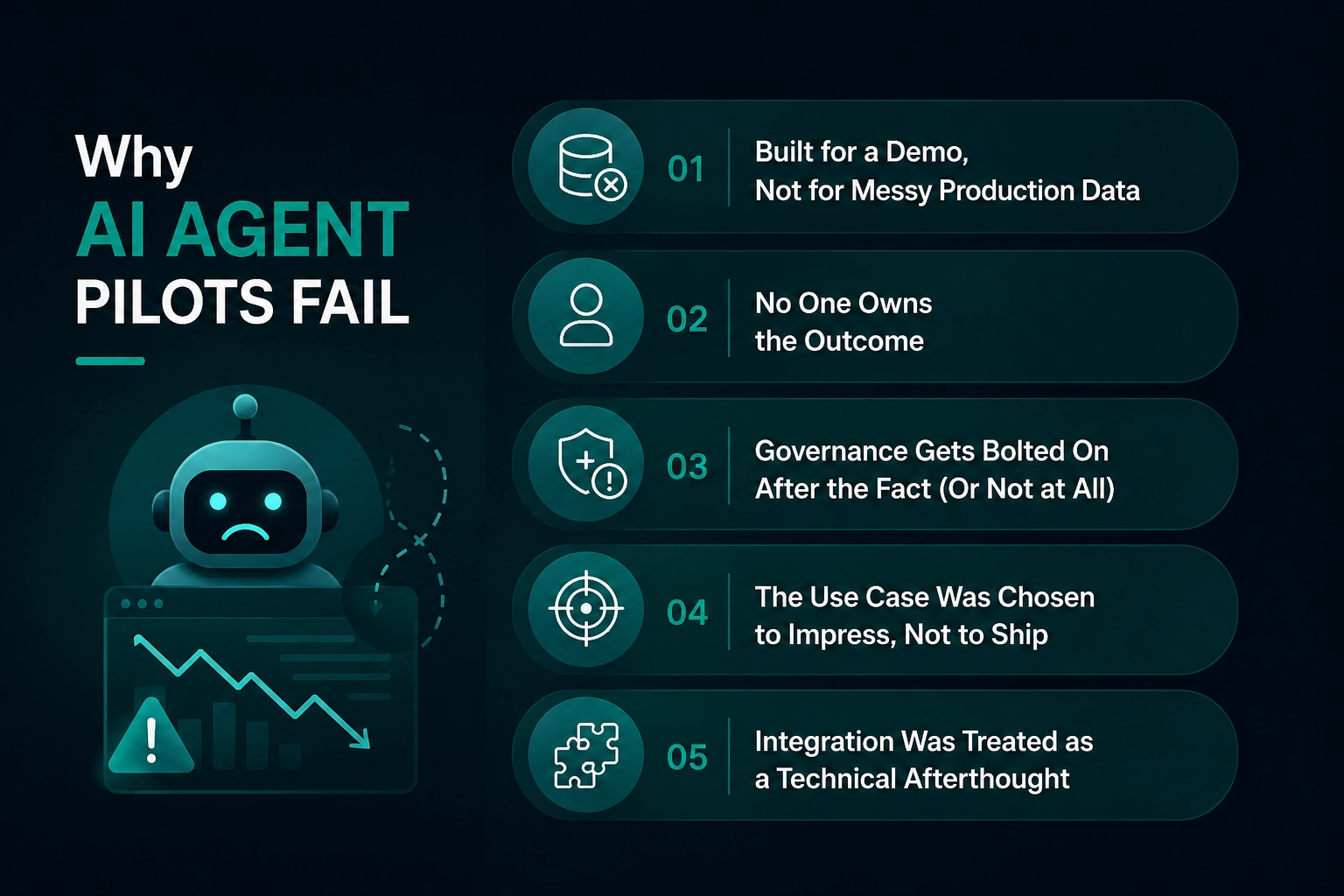
1. The Pilot Was Built for a Demo, Not for Messy Production Data
Pilots typically run on clean, hand-picked data — a curated spreadsheet, a staging API returning predictable results, a small test dataset with no missing fields. Production looks nothing like that. Real systems have inconsistent formats, legacy databases with no documentation, duplicate records, and edge cases nobody thought to test for because they never showed up in the sample data.
This shows up in a few predictable ways:
- Format drift — a field that was always populated in test data turns out to be frequently blank or malformed in the live system.
- Volume and concurrency — an agent that handles one request at a time cleanly starts producing inconsistent results once multiple requests hit it simultaneously.
- Undocumented systems — the pilot connected to a clean API; production requires connecting to a twenty-year-old system whose only export method is a nightly batch file.
An agent that performs flawlessly on curated data can fall apart the moment it meets the actual, unglamorous state of your company’s real systems. This is rarely visible during the pilot phase, precisely because the pilot was never exposed to the mess in the first place.
2. No One Owns the Outcome
A surprising number of stalled AI agent projects have no single person accountable for whether the agent actually delivers business value. The pilot lives inside an “innovation team” or IT sandbox, disconnected from the operational leader who would actually be responsible for the workflow it’s meant to improve.
Without a clear owner, a few things tend to happen: no one is measuring the right business metrics, no one is pushing the project past the demo stage when it stalls, and no one’s performance review depends on whether it actually succeeds. The project survives on enthusiasm, and enthusiasm fades faster than most people expect.
Contrast this with how most companies handle a new hire in an operational role: someone in the business is accountable for that person’s output, their onboarding, and their ongoing performance. AI agents that reach production tend to be treated the same way — as something a specific person owns end-to-end, not a shared side project.
3. Governance Gets Bolted On After the Fact (Or Not at All)
Pilots often run in an environment with looser oversight, precisely because it’s “just a test.” That works fine for a demo. It becomes a serious liability the moment an agent starts taking real actions — sending customer communications, updating records, or making decisions that used to require a human sign-off.
Many organizations discover they need approval workflows, audit logs, and clear rules for what an agent is and isn’t allowed to do — only after the pilot has already proven the concept, which means retrofitting governance under time pressure instead of designing it from the start. Retrofitting is almost always slower, more expensive, and more disruptive than building it in from day one, because by that point the agent is already touching live processes that can’t simply be paused while governance gets sorted out.
A useful test: if you asked your team right now “who approved what this agent is allowed to do without a human in the loop, and where is that documented?” — could they answer immediately? If not, that’s a governance gap waiting to surface at the worst possible time.
4. The Use Case Was Chosen to Impress, Not to Ship
It’s common for teams to pick the most impressive possible use case for a pilot — something broad, ambitious, and demo-friendly — rather than the most production-viable one. A flashy, open-ended assistant that can “do anything” tends to perform inconsistently once it meets real-world ambiguity, because broad scope multiplies the number of edge cases the agent has to handle correctly.
The organizations that actually reach production tend to start narrower: a single, well-defined task with a measurable output — document classification, data extraction, routing a support ticket — rather than a general-purpose agent expected to handle anything thrown at it. It’s a less exciting pitch in a leadership meeting. It’s dramatically more likely to still be running in a year.
5. Integration Was Treated as a Technical Afterthought
Connecting an agent to your actual CRM, ERP, or internal databases — with proper authentication, rate limits, and error handling — is often harder and more time-consuming than building the agent itself. Teams that treat integration as a footnote at the end of the project, rather than a core part of the scope from day one, are the ones most likely to get stuck.
Integration work that gets underestimated typically includes:
- Handling partial failures gracefully (what happens when a downstream system times out mid-task?).
- Managing authentication and permissions across multiple systems, not just one clean API.
- Respecting rate limits on legacy systems that were never designed for frequent automated calls.
- Keeping the agent’s view of data in sync with systems that update on their own schedules.
Warning:
If your project plan has “connect to production systems” as a single line item near the end of the roadmap, that’s a strong sign integration hasn’t been scoped realistically — and it’s very likely to become the reason the timeline slips.
The Hidden Cost of Staying in Pilot Purgatory
It’s worth being direct about what pilot purgatory actually costs, because it’s rarely zero — even though it often gets treated that way internally.
- Direct spend — licensing, cloud compute, and vendor costs continue for a project that isn’t producing measurable value.
- Team time — engineers and product staff continue maintaining a pilot that never scales, time that could go toward a narrower, more viable project.
- Opportunity cost — every month spent maintaining a stalled pilot is a month not spent learning from a real production deployment.
- Organizational trust — repeated stalled AI initiatives make it harder to get budget and buy-in approved for the next AI project, even a genuinely well-scoped one.
- Morale — teams that build something that works, only to watch it quietly die from lack of ownership, tend to become more skeptical of future initiatives — a cost that’s hard to quantify but very real.
None of this means pilots are a waste of time. It means an honest cost-benefit conversation should include what continuing to fund a stalled pilot is actually costing, not just what building a new one would cost.
A Realistic Example: Demo vs. Production
To make this concrete, here’s a simplified, illustrative comparison of how the same idea — an AI agent that handles customer support inquiries — looks different at the pilot stage versus in real production use.
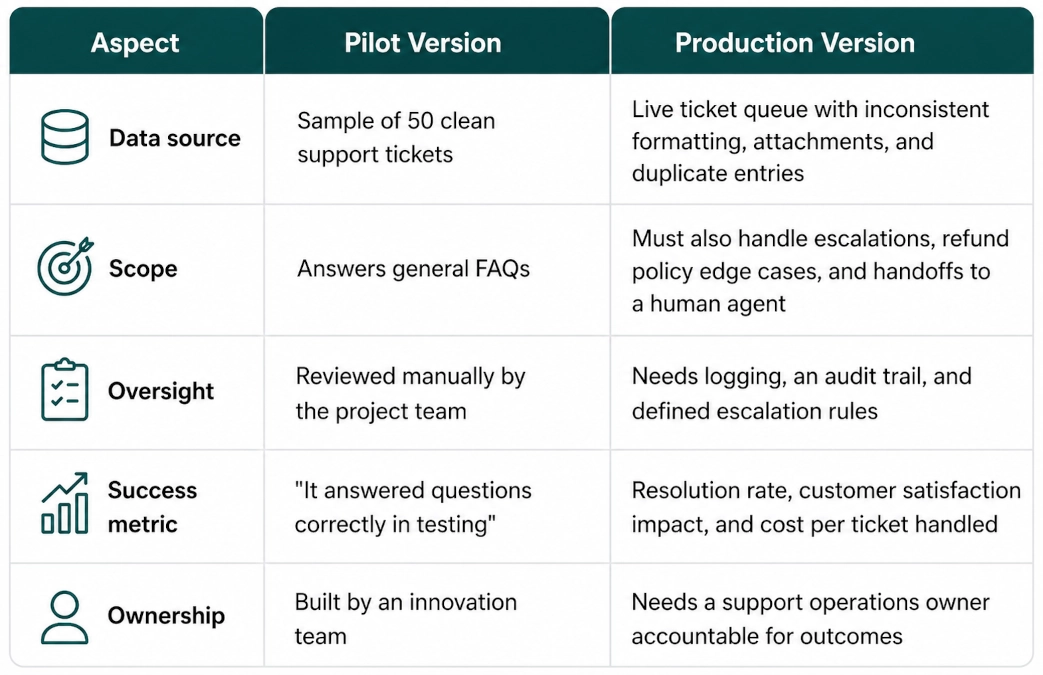
The core AI capability barely changes between these two versions. Almost everything else — data quality, scope, oversight, ownership, and failure handling — does. This is the actual distance between “the pilot worked” and “the production system works,” and it’s a distance measured in operational planning, not model quality.
If you checked "not yet" on more than one or two items above, it's worth getting an outside read before you scale further.
How to Be in the Minority That Actually Ships
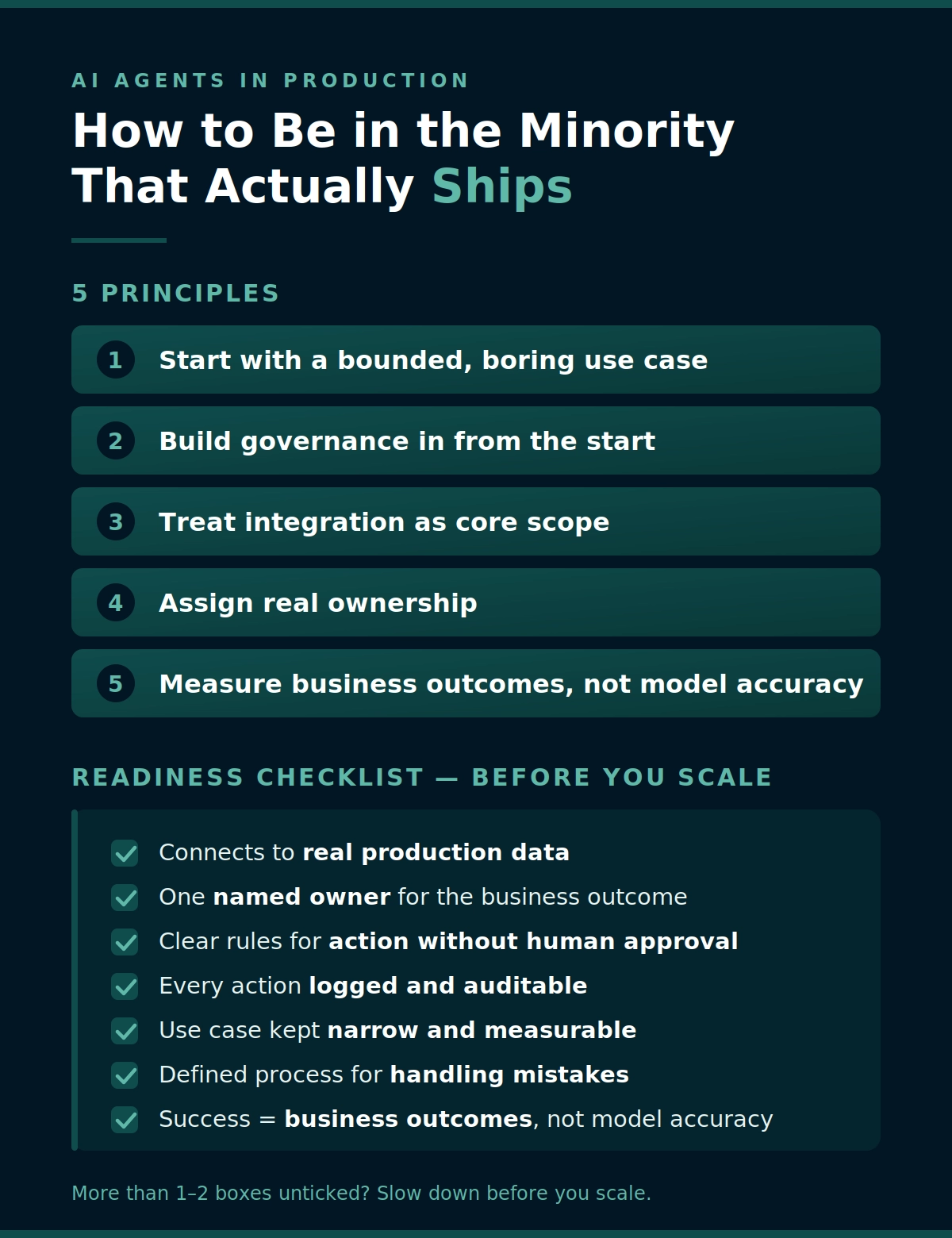
Start With a Bounded, Boring Use Case
Choose a narrow, well-defined task with a clear, measurable outcome. It won’t make for the most exciting demo, but narrow use cases are dramatically more likely to survive contact with production reality — and you can always expand scope once the narrow version has proven stable.
Build Governance In From the Start
Decide up front: What is the agent allowed to do without human approval? How is every action logged? Who reviews mistakes, and how quickly? Answering these questions before launch, not after a stalled pilot forces the issue, saves months of retrofitting later.
Treat Integration as Core Scope, Not a Detail
Budget real time and engineering effort for connecting the agent to your actual systems — not a sanitized test version of them. If integration work isn’t explicitly planned and staffed, assume it will become the reason the project stalls.
Assign Real Ownership
Someone with operational accountability — not just a technical team — needs to own whether the agent is actually delivering value. That person should have a stake in the outcome, not just in the technology working.
Measure Business Outcomes, Not Model Accuracy
Model accuracy and response quality are interesting engineering metrics. They’re not what justifies continued investment. Track time saved, cost per task, error rates that matter to the business, and customer or employee impact. If you can’t answer “what did this save us,” it’s hard to justify moving past the pilot stage.
A Simple Readiness Checklist Before You Scale
Before expanding an AI agent pilot beyond its initial test group, it’s worth honestly answering these questions:
- Does the agent connect to real production data, not a curated sample?
- Is there a single, named owner accountable for the business outcome?
- Are there clear rules for what the agent can do without human approval?
- Is every agent action logged in a way that can be audited later?
- Has the use case been kept narrow and measurable, rather than broad and open-ended?
- Is there a defined process for what happens when the agent makes a mistake?
- Have you defined success in terms of business outcomes, not just technical performance?
If more than one or two of these are still “not yet,” that’s not a reason to abandon the project — but it is a reason to slow down before expanding it further.
What This Means If You're Evaluating an AI Agent Project Right Now
If you’re a team lead or senior decision-maker looking at an AI agent proposal, the most useful question isn’t “can this technology do what’s being promised?” It almost always can, in a controlled setting. The better question is: has anyone planned for what happens when this leaves the controlled setting?
That single distinction — treating production readiness as a starting requirement rather than a later phase — is what separates the organizations quietly stuck in pilot purgatory from the smaller group actually getting value from AI agents today.
Not sure whether your AI agent pilot is close to production-ready, or quietly stuck in pilot purgatory?
Conclusion
The gap between AI agent pilots and real production use isn’t a technology problem — it’s an organizational one. The businesses that succeed aren’t the ones with the most impressive demo. They’re the ones that treated production readiness as a requirement from day one: clear ownership, real governance, honest data, and a narrow enough scope to actually test properly.
If your organization is sitting on a promising pilot that hasn’t gone anywhere in a while, that’s not a sign to give up on AI agents. It’s a sign to take an honest look at what’s actually missing before scaling further — and, often, a sign that the fix has less to do with the AI and more to do with the plan around it.
FAQs
Not necessarily. Most failures trace back to organizational gaps — data readiness, governance, ownership — rather than the underlying AI capability itself.
There’s no universal number, but many successful deployments prove a narrow use case is stable for a sustained period — often several months — before expanding scope, rather than scaling immediately after an initial positive demo.
Clear, accountable ownership of the business outcome tends to matter more than budget or technical sophistication. Projects with a named owner responsible for results are far more likely to survive past the pilot stage.
Not entirely — but it’s usually better to prove value with a narrow, bounded use case first, then expand, rather than starting with an ambitious, open-ended agent that’s harder to govern and test.
It applies more broadly to AI and technology projects overall, but the gap tends to be more pronounced for autonomous AI agents, since they take actions rather than just generating suggestions, which raises the stakes around governance and oversight.
Use the readiness checklist in this article as a starting point — if governance, data readiness, and ownership are still undefined, it’s worth addressing those before expanding scope.