
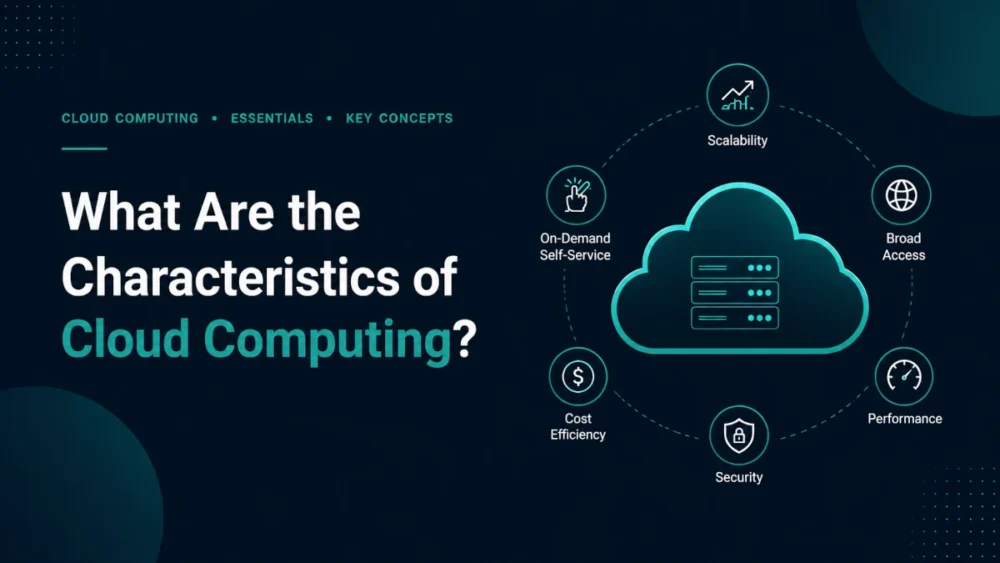
Cloud computing is distinguished by five foundational characteristics established by NIST — on-demand self-service, broad network access, resource pooling, rapid elasticity, and measured service — complemented by contemporary attributes such as scalability, high availability, security, automation, cost efficiency, and disaster recovery. Collectively, these characteristics empower organizations to harness computing capacity over the internet instantaneously, pay solely for consumption, and scale up or down without owning physical hardware.
- Five NIST characteristics define authentic cloud computing: on-demand self-service, broad network access, resource pooling, rapid elasticity, and measured service.
- Modern cloud introduces six additional attributes: scalability, high availability, security, automation, cost efficiency, and disaster recovery — rendering it viable for mission-critical enterprise use.
- The pivotal transformation is ownership → access: organizations rent computing capacity and pay exclusively for what they consume, rather than purchasing hardware.
- Elasticity + scalability resolve the demand challenge: resources expand instantly for surges and grow sustainably over time, unconstrained by hardware limits.
- These characteristics = tangible business value: reduced costs, accelerated launches, superior uptime, and global reach — the reasons cloud adoption continues to accelerate across industries.
Contents
- 1. What Is Cloud Computing?
- 2. What Are the Core Characteristics of Cloud Computing?
- 3. Additional Characteristics of Modern Cloud Computing
- 4. Why Are the Characteristics of Cloud Computing Important?
- 5. Benefits of Cloud Computing Characteristics
- 6. Real-World Examples of Cloud Computing Characteristics
- 7. Conclusion
- 8. FAQs
Table of Contents
ToggleWhat Is Cloud Computing?
Cloud computing is the delivery of computing services — servers, storage, databases, networking, and software — over the internet rather than through on-premises hardware. Instead of procuring and maintaining physical infrastructure, organizations rent computing resources from a cloud provider such as AWS, Microsoft Azure, or Google Cloud, and pay according to actual consumption.
The characteristics of cloud computing are precisely what distinguish it from conventional IT environments. They articulate how cloud services are delivered, accessed, shared, and billed. Grasping these characteristics is the essential first step toward understanding why cloud adoption has become the default choice for startups, enterprises, and even specialized disciplines like chip design and engineering simulation.
What Are the Core Characteristics of Cloud Computing?
The National Institute of Standards and Technology (NIST) identifies five essential characteristics that define authentic cloud computing. If a service lacks even one of these, it typically doesn’t qualify as “true” cloud computing — it’s merely internet-hosted software.
On-Demand Self-Service
Users can provision computing resources — servers, storage, or applications — precisely when they require them, without contacting the provider or awaiting human approval. Everything is orchestrated through a self-service dashboard or API, enabling a developer to spin up a virtual machine within minutes rather than submitting a request and waiting days for IT to respond.
Broad Network Access
Cloud services are accessible from anywhere, over standard internet connections, using virtually any device — laptops, smartphones, or tablets. This characteristic is precisely what makes remote work, global teams, and around-the-clock access achievable, since the sole prerequisite is a network connection rather than a specific device or location.
Resource Pooling
Cloud providers serve multiple customers from shared physical infrastructure through a multi-tenant model. Computing resources — processing power, memory, storage, and bandwidth — are pooled together and dynamically allocated according to demand. Customers generally don’t know (nor need to know) the precise physical location of their data, though many providers permit them to select a general region for compliance purposes.
Rapid Elasticity
Resources can scale up or down almost instantaneously to align with demand, and in many instances this occurs automatically. A retail website can add server capacity during a flash sale and relinquish it once traffic subsides, ensuring the customer only ever pays for the capacity genuinely required — with no ceiling imposed by physical hardware.
Measured Service
Cloud systems automatically monitor and report resource usage — storage consumed, compute hours used, data transferred — establishing a transparent, pay-as-you-go billing model. This metering benefits both parties: customers pay only for consumption, and providers can optimize how resources are distributed across their infrastructure.
Cloud Computing vs. Traditional Computing
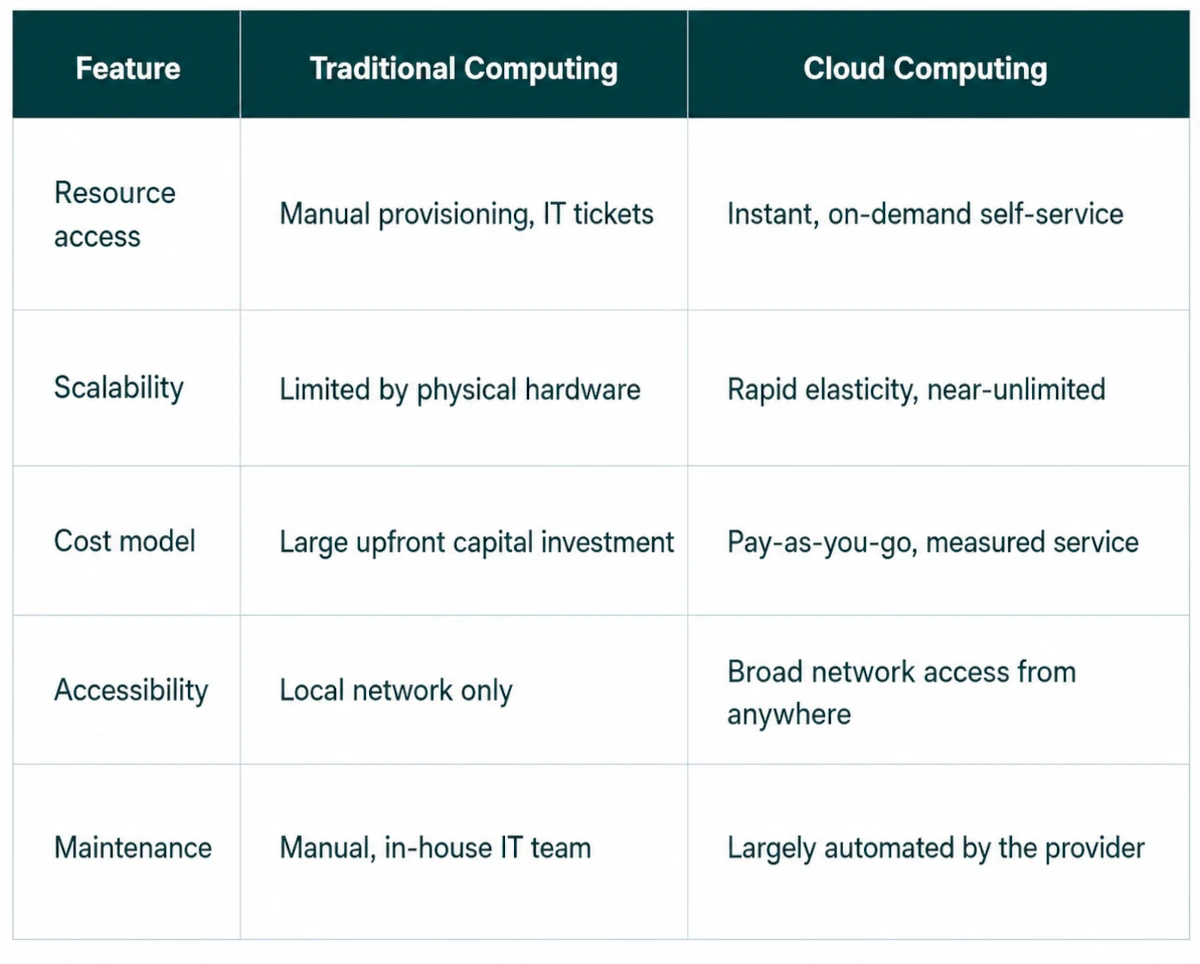
This comparison illustrates why the characteristics of cloud computing are frequently described as a transition from ownership to access — organizations no longer need to own infrastructure to reap its benefits.
Ready to move from owning hardware to accessing it on demand? Let's map the right cloud strategy for your business.
Additional Characteristics of Modern Cloud Computing
Beyond NIST’s original five, modern cloud platforms have cultivated further characteristics that render them practical for mission-critical enterprise use.
Scalability
Intrinsically linked to rapid elasticity, scalability is the cloud’s capacity to accommodate long-term growth — more users, more data, more workloads — without an organization needing to purchase new physical infrastructure. It supports both scaling up (augmenting existing resources with more power) and scaling out (adding more instances).
High Availability
Cloud architectures are engineered with redundancy at their foundation: multiple servers, data centers, and failover systems ensure that if one component fails, another assumes its role instantly. This minimizes downtime and keeps applications operational even amid hardware failures or maintenance.
Security
Cloud providers implement layered safeguards — encryption in transit and at rest, identity and access management, multi-factor authentication, and continuous monitoring — to protect data. While security remains a shared responsibility between provider and customer, modern cloud platforms generally deliver stronger baseline protections than most individual organizations could construct independently.
Automation
Routine tasks such as software updates, infrastructure provisioning, backups, and performance monitoring are executed automatically. This alleviates the manual burden on IT teams and diminishes the likelihood of human error in repetitive operations.
Cost Efficiency
Because cloud computing eliminates substantial upfront hardware investments and adheres to a consumption-based pricing model, organizations convert fixed capital expenditures into flexible operating expenditures. Coupled with measured service, this makes budgeting more predictable and avoids paying for idle capacity.
Disaster Recovery
Cloud platforms typically replicate data across multiple locations, making recovery from outages, cyberattacks, or natural disasters considerably faster and more economical than traditional, single-site backup systems. Recovery that once required days can frequently be accomplished in hours or minutes.
Why Are the Characteristics of Cloud Computing Important?
Each characteristic addresses a specific problem that traditional IT infrastructure struggled to overcome:
- On-demand self-service eliminates IT bottlenecks and manual provisioning delays.
- Broad network access enables remote work and global collaboration.
- Resource pooling and measured service reduce costs by sharing infrastructure efficiently.
- Rapid elasticity and scalability allow organizations to manage unpredictable demand without over-investing in hardware.
- Security, high availability, and disaster recovery safeguard business continuity in ways that are costly to replicate on-premises.
For students and IT professionals, mastering these characteristics is also fundamental for cloud certifications (AWS, Azure, GCP), system design interviews, and constructing real-world cloud architecture. Roles such as cloud engineer, cloud architect, DevOps engineer, and cloud security specialist all demand a working command of exactly how these characteristics operate in concert, since interview questions and real production incidents frequently trace back to one of them — a scaling failure, a billing anomaly, or a security misconfiguration.
Benefits of Cloud Computing Characteristics
When these characteristics operate in harmony, they translate into concrete business advantages:
- Lower costs — pay-as-you-go pricing avoids wasted expenditure on idle infrastructure.
- Faster time-to-market — self-service provisioning means new products and features launch sooner.
- Business continuity — high availability and disaster recovery diminish the impact of outages.
- Global reach — broad network access connects teams and customers from anywhere.
- Operational efficiency — automation reduces manual IT work and human error.
- Flexibility to experiment — elasticity lets teams test new workloads without long-term commitments.
These benefits explain why cloud adoption continues to accelerate across industries, from small startups to highly regulated sectors like finance and semiconductor design.
Real-World Examples of Cloud Computing Characteristics
- Streaming services depend on rapid elasticity and scalability to absorb traffic surges when a new season or major release goes live, automatically adding server capacity and releasing it afterward.
- Cloud storage platforms exemplify broad network access and resource pooling by allowing users to sync files across phones, laptops, and tablets from shared, multi-tenant data centers.
- E-commerce platforms leverage on-demand self-service and measured service during high-traffic events like seasonal sales, scaling checkout systems instantly and billing based on actual usage.
- Engineering and chip design workflows increasingly operate on the cloud so specialized software licenses and high-performance computing resources can be accessed on-demand rather than maintained on expensive in-house hardware, combining measured service with elasticity for compute-intensive simulations.
- Enterprise backup systems employ disaster recovery and high availability characteristics to replicate critical data across regions, ensuring operations continue even if one data center goes offline.
Thinking about moving to the cloud? I'll help you plan a smooth, cost-efficient migration — no guesswork. Start the conversation.
Conclusion
The characteristics of cloud computing — from NIST’s foundational five to modern additions like security, automation, and disaster recovery — define why cloud platforms have supplanted traditional IT infrastructure for most businesses. On-demand access, elastic scaling, pooled resources, and pay-as-you-go billing combine to deliver flexibility and cost savings that physical servers simply cannot match. Whether you’re a student preparing for a cloud certification or a business planning a digital transformation, understanding these characteristics is the foundation for making smarter cloud decisions.
FAQs
The five NIST-defined characteristics are on-demand self-service, broad network access, resource pooling, rapid elasticity, and measured service.
There’s no single “most important” one — they function as a set. That said, rapid elasticity and measured service are frequently emphasized because they directly drive cost savings and flexibility.
Rapid elasticity refers to fast, often automatic, short-term scaling in response to demand spikes. Scalability is the broader, long-term capacity to grow a system’s resources as a business expands.
Security isn’t among NIST’s original five, but it’s widely acknowledged as an essential modern characteristic, since data protection is pivotal to cloud adoption.
Because these characteristics directly determine cost, flexibility, uptime, and how swiftly a business can respond to shifting demand — factors that shape competitiveness and customer experience.
Not always. A service must possess the five NIST characteristics to qualify as “true” cloud computing. The additional characteristics — such as disaster recovery or automation — vary by provider and service tier, so it’s worth verifying a provider’s specifics before assuming they’re included.